
Building Tall, Actions
Part 4, Actions – Concentrating Meaning

meta: This is part 4 of Building Tall. As it turns out, I was completely stumped on how to express Part 3 – Relationships. I may still find a way to do the Relationships one, or it might come by some other means.
This is part 4 of the Building Tall series. Consider also, part 1 and part 2.
Many years ago, in a spell of needing to be more productive, I asked a mentor for advice on how to read more, like “3 times as many books as I’m reading now.”
“Instead of reading 3 times more books, can you read 3 books-worth out of one book?”
In the last post of the series, I want to take the idea of Building Tall and apply it to the atomic components of our daily lives – our Actions.
Personal Actions
All the way until adulthood, the idea of composting was foreign to me. I was vaguely aware that some industrial applications benefited from composting, but doing it myself was somewhere around “unimaginable” and “beneath me”. There was only one category in my mind growing up – garbage. Somewhere in my early teens, I developed a new category: Recycling. However, composting didn’t really become a thing until I moved into a shared house with others.
“Ugh, cleaning out the food and deliberately put it in a bin to be thrown out separately. So gross and effortful.” I would think to myself.
Though, for convoluted reasons, I became more interested in biology. Not just the protein and enzyme kind, but also the permaculture kind. These ecological models started to click real well with other subjects I wanted to learn about, providing inspiration for other domains. Over time, composting actually became super cool! I try to do it more, whenever possible. Failing to compost is now accompanied by a distinct sense of discomfort.
Meanwhile, I have kept relatively long hair since COVID. It’s still fairly foreign to me, especially the part where I keep finding long strands of hair all over the place and needing to do a double take – hey, this is my hair! When I run my hand through my hair, sometimes loose strands come along with the brushing motion. The question then arises: What do I do with loose strands of hair?
Compost it, of course!
Another question arises, though, when it comes to a pragmatic consideration of opportunity costs.
Suppose I’m sitting at my desk and a stray strand of hair was found. To dedicate enough attention to it, get up from my chair, walk to the compost bin, brush it off my hands, only to walk back to my chair and probably lose the thread of whatever I was doing… Is this worth it? Isn’t this just unnecessarily increasing entropy in the universe? Why would I go through all this trouble?
Changing the frame of reference, however, away from the notion of opportunity cost, and instead consider it a different way. Insofar as a single strand of composted hair is ~inconsequential and most loose strands of hair are ~unaccountable, such a “trivial” action becomes almost entirely weighed by its symbolism – its meaning. The Herculean effort (relative to the utility of the action) to go so deliberately out of my way to compost a strand of hair is then an action that indicates to observers (in this case myself) the weight of the value.
In other words, when someone is taking an action that has little “apparent” value, if they are going through disproportionate effort to accomplish said action, then we can account for the cost-benefit asymmetry by inferring that there is a lot of “hidden” value. Often, the “hidden” value can be discovered by examining the “meaning” of the action.
This can be very obvious when illustrated. The “meaning” of “a drink of water” to someone lost in a desert and an urbanite with drinkable tap water is radically different. The effort they would undertake to accomplish the action is also radically different.
However, this can be less clear, sometimes even intractable to communicate, when we examine other cases.
Consider the case of Amar Bharati, or “guy who kept his arm raised for 50 years”. Why would someone do something like this? Even more strangely, why would people find this inspiring – to the extent that some even copied his gesture?
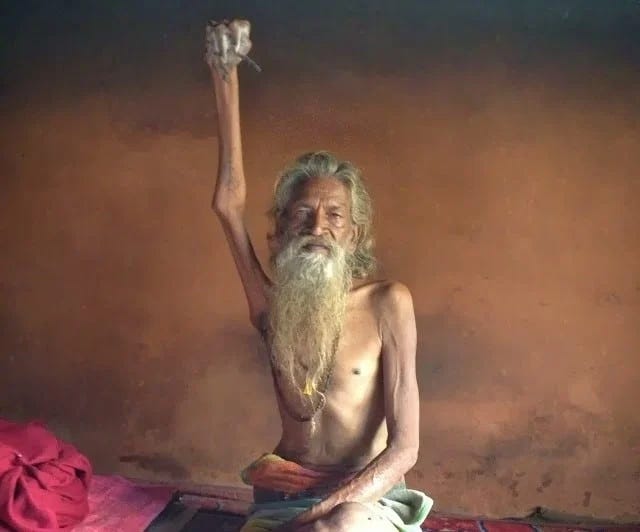
Well, it’s not like he’s hiding the why or anything:
“I do not ask for much. Why are we fighting our sons among ourselves? Why is there so much hatred and enmity between us? I just want all Indians and the whole world to live in peace with each other.”
And, so, as a testament of his devotion to Shiva, in order “to militate against wars and support world peace", he raised his arm and just … didn’t put it down.
If my “Herculean” effort to compost a strand of hair illustrates at all the significance of the value of composting is to me, then Amar Bharati has surely illustrated the significance to himself and others just how important world peace is to him.
Importantly, one doesn’t need to have a devotion to Shiva, or a particular affinity for World Peace to “appreciate” the action. Without needing to agree with his cause or method, one can be struck by the cost of his undertaking. “I mean, I’m not sure why anyone would go that far or if it’s even a good way to go about it, but he clearly cares about this.”
Through the cost and significance of the action, it creates a feedback loop that foregrounds the more ineffable “meaning” behind the action. Every bit of “cost” towards the value or meaning reinforces the value itself. The value, reinforced, then facilitates the next action towards this. Devotion towards some value enters a positive feedback loop – devotion begets devotion.
Collective Actions
There’s a general class of problems that I hold as underpinning much of global issues like climate change or various arms races. These are Collective Action problems. As we examine the meaning behind our and each other’s actions, we also gain insight and a lever into evaluating and coordinating collective action problems.
In economics, there is a type of game played to evaluate sociality within a group of people. One popular example is the Ultimatum Game. In it:
One player, the proposer, is endowed with a sum of money. The proposer is tasked with splitting it with another player, the responder (who knows what the total sum is). Once the proposer communicates their decision, the responder may accept it or reject it. If the responder accepts, the money is split per the proposal; if the responder rejects, both players receive nothing.
To give an example, if you were given $100, and have to choose to give me some portion of the money to share (between $0-100), what would you give me, knowing that if I don’t like it (e.g. you only give me $5), I can decide that both of us don’t get money.
Interestingly, modeling this game with “rational agents”, the logic goes that you should give me the absolute minimum above $0 because from my “rational” perspective, my return is positive if I accept anything above $0, but my return would be nothing if I turn your offer down, whatever the offer is. Knowing this, you would give me something minimally above $0 so that you can maximize your returns, knowing I would accept it. This would even be true if we were thinking about the game in a contextless, abstract sense.
Reality, of course, obliterates this naive notion of “rational agents”. We are often willing to incur “cost” in order to protect an abstract value, such as “fairness”. If I give you $1 and keep $99, you are likely to feel the inappropriateness of the action and reject the deal so that neither of us gets money. Not only that, you probably learned that I’m not someone you would like to cooperate with in the future. ~Instinctually, sociality is a part of our psychosocial makeup.
However, depending on how the game is set up, we can influence the degree of sociality present in the relationship. We can probably imagine that players from egalitarian tribes may display different patterns than investment bankers. Similarly, we can imagine a loving parent-child duo playing this game would also be different than a couple with an abusive relationship.
What these tags (egalitarian tribe, abusive relationship, etc) influence is the meaning that is woven through the game, or how is the game embedded?
“Why would such a game be played?”
“Who are the other players to me and me to them?”
“What would they think or do if I were selfish or cooperative? What would I think of them?”
“What is the meaning if we were different from each other? If we were the same?”
“Why would I want to be selfish or cooperative? What about them?”
Questions like these are invisibly and invariably considered as we make such a decision. Arriving at variance across cultures, across relationships, across moods.
Having considered these questions, our actions are then a reflection of what we think. For those in observance (whether that is ourselves, others, god, or spirits), we signal what we think and how to coordinate with us.
The person who’s playing the ultimatum game purely for selfish utility and the person who’s playing while considering what the game says about the world inhabit different worlds and thus live out very different lives.
One day in 1671, Christopher Wren observed three bricklayers on a scaffold, one crouched, one half-standing and one standing tall, working very hard and fast. To the first bricklayer, Christopher Wren asked the question, “What are you doing?” to which the bricklayer replied, “I’m a bricklayer. I’m working hard laying bricks to feed my family.” The second bricklayer, responded, “I’m a builder. I’m building a wall.” But the third brick layer, the most productive of the three and the future leader of the group, when asked the question, “What are you doing?” replied with a gleam in his eye, “I’m a cathedral builder. I’m building a great cathedral to The Almighty.”
Actions are powered by meaning, and meaning is kaleidoscopically diverse. When the meaning of an action is powerfully aligned, an individual (or a group) can do incredible things, from jumping on a grenade to protect others to creating generation-defining art.1
In the story, the cathedral builder is taking a “tall” action. It’s tall not only in the sense that it has the “grandest” of meanings but also that to relate properly to that grand meaning, the “lesser” layers of meaning like “building a wall” and “laying a brick” are just as important. The cathedral builder should know that if they were to think laying bricks and building walls as beneath them, because their vision is only the grandest of cathedrals, then no cathedral will ever come to fruition. Every brick laid with care is what adds up to the greatest of monuments.
It’s precisely when all of the layers of meaning are present that the tallness of the action is most proper. If the action comes only from the most grand layer, then what results is not an art of Greatness, but mere grandiosity.
It’s also worth noting that Greatness does not necessarily need to express itself in conventional ideas of greatness. The story itself also hints at alternatives: the action of laying bricks to feed my family and building a wall because I’m a builder are all perfectly fine paths to enable tall actions. There is no shortage of stories of artistry or heroism in providing for one’s family or appreciating one’s vocation.
A path for tall actions can come from anywhere because meaning can emerge from anywhere.
Meaning, held as an emergent property of all interactions, leads people to found empires, burn books, create new science, commit murder, meditate for decades, get married, get divorced, and every action in between.
And as each action etches its mark onto the world, we also communicate to ourselves and those around us what we think this world is, informing where subsequent meaning and actions come from. Round and round, weaving our relationships, institutions, and the very society we live in.
Reminds me of "The Elephant in the Brain" but leaning more into the sense of personal meaning instead of into interpersonal interaction