
Building Tall, Institutions
Part 2, Institutions – Discovering and Building Beauty

As cities can be “tall”, so can institutions.
A simple comparison might be a small town one-building school with 50 students, compared to a 10,000-student university campus.
It should be straightforward that the latter is more complex than the former. The straightforwardness of the comparison should come from the fact that the university campus is simply “greater” in most dimensions. The university campus is both more “wide” and “tall”. Wide in the sense that there are more buildings, cover a greater area, and have a bigger population. It’s also tall in the sense that there are more layers baked into its usage – a lecture hall may be used for lectures, conferences, and theatre.1
However, we may confuse the picture a bit by adding some nuance.
Suppose the university campus is not particularly notable, known as one of the universities that co-exists with 5 other similarly unremarkable universities in the same city. It doesn’t produce research results or extracurricular activities as it’s more so a degree mill where 60% of the students are part-time or online attendees. In contrast, the small town school is the only one in the area. It educates nearly all children in the surrounding region with a remarkable integration of its retired educated population, while functioning as a nexus for many of the town’s political, social, and economic functions.
In this picture, it might become less clear which is more “complex”. We might imagine that this updated description means the university is still wide but lost some of its “tallness”, while the small town school has gained “tallness”.
By now, we have started to gain some handles on what “tallness” is. It should relate closely to ideas like “density of coherent meaning” and “high in dimensionality or complexity”. In everyday speak, when we sense “tallness”, we might describe it with words like “richness” or “depth”.
Or: To be “tall” is to be imbued with complexity, with life. Tallness isn’t only density, but rather a density of coherent differences, a density of plurality, a plurality that endures.
That said, tallness can, at least for me, feel a bit ephemeral – difficult to pin down as a formalized, generally applicable description. However, I find it’s often a good trick to infer how “tall” X is by looking at how X perceives the world. This is to say, if there are more ways (i.e. dimensions) a city, institution, or person, perceives reality, the more tall they are likely to be – they are able to discern more aspects of relevance in the world.2
In the case of institutions, we can get a better handle on institutional “tallness” by evaluating how they perceive the world: Metrics.
Metrics, as a metric for institutional tallness
Take, for example, a school again.
The modern metric for school is the grading system. Whether by percentage or letter grade, we assign a label on one dimension on which a student’s performance is evaluated. The label is then consolidated on a “transcript” (an institutionally legible artifact) that conveys to other associated institutions the “nature” of the student the transcript is describing. The stakes of these labels can be extraordinarily high, from the Chinese Gaokao to the Indian JEE, people hold very firm beliefs about the consequences of not performing well along the dimension that schools find legible.
Fortunately though, even in the toughest testing environments, semblances of human diversity are difficult/impossible to erase. Even if one is bad at studying, there’s still a path for the extraordinary musician. Even if someone failed the CSAT (Korean Gaokao), they can still (try to) go pro in Starcraft.
And insofar as schools claim that their mission is about raising mature, capable human beings who can be good citizens, the institutions necessarily need to foster developments in these other dimensions that don’t easily compress to a grade.
Helpfully, more and more education institutions give openings for these possibilities. College applications generally seek more than just a transcript to summarize one’s learnedness. Descriptions of extracurricular distinctions and personal essays of hopes and dreams are an increasingly common part of the admission process.
However, as any administrator know, the more aspects of an applicant get included, the more disproportionately energy-intensive it requires to evaluate. It’s pretty easy to have a 90% cut-off, but it’s far harder to consider who in the applicant pool is “holistically” a better fit. Adding more metrics to evaluate often creates more noise instead, hindering the aim of composing a class of students filled with Life.
In addition, more metrics are not only difficult for administrators but hard for students too. Not only do you have to get an A in every subject under the sun, you will also need to volunteer to show your compassion, start a company to show your leadership, and publish a paper to show your intellect. As any keenly prepped high school senior knows, this is an exhausting way to live. It quickly becomes an emulation of tallness often precisely at the cost of developing rich character.
Ok, so simply opening the floodgates for more metrics isn’t helpful, then what do we do? How can we get closer to the kind of lofty function of education someone like E.F. Schumacher wishes for:
“Education can help us only if it produces “whole men.” The truly educated man is not a man who knows a bit of everything, not even the man who knows all the details of all subjects (if such a thing were possible): the “whole man,” in fact, may have very little detailed knowledge of facts & theories…but he will be truly in touch with the centre. He will not be in doubt about his basic convictions, about his view on the meaning and purpose of his life. He may not be able to explain these matters in words, but the conduct of his life will show a certain sureness of touch which stems from his inner clarity.”
The quote itself, I think, contains some hints for the solution. More metrics aren’t necessarily workable, in the wider sense of metric, but metrics can also be more “tall”.
To be “in touch with the center” that “stems from her inner clarity” are examples of tall metrics. It can be difficult to explicate exactly what that means, but, suppose we could accurately measure this, then surely we would like to use it.
In a sense, we are making metrics more abstract. Abstract not in the sense that it’s reductive or becomes removed (e.g. letter grade), but rather in the sense that they contain “more” (e.g. evaluating curiosity). The trade-off here, is that a reductive/simple metric is easy to measure but lossy in signal, but a more abstract/tall metric contains high signal though usually at the cost of measurability.
This description itself may sound abstract, but consider a simple example.
Suppose I want to carry as much water as possible from point A to B. To do so I have many vessels to choose from. One way I can measure which is the best vessel to use is by choosing the one with the largest area (i.e. horizontal cross-section) or I could choose the one with the largest volume. It might seem silly; obviously volume is the superior metric here. However, the largest area is not necessarily “bad”. By reducing the dimensions of measurement, just looking at which vessel is wider can often be an ok proxy for volume. We also intuit volume being better because we are equipped to understand 3-dimensional space but suppose I am a creature of flatland, I would have trouble using 3-D metrics like volume to make my choice. Volume here is an example of a “taller”, more abstract metric than area by it containing more “dimensions” without losing details of any other dimensions.
With the idea of a “taller” metric, we can reconnect our exploration around metrics with the tallness of institutions.
If an institution is able to use a diverse set of metrics, especially incorporating “taller” metrics, we can infer the institution’s tallness. Specifically, the usage of tall metrics helps us infer the institution’s ability to perceive tallness. The ability to perceive tallness is the actual/desired metric for institutional tallness.3
An entity capable of perceiving tallness has the capacity to be tall, as illustrated by the example of the difference between how volume vs area is naturally or unnaturally used as a metric by a 3D or 2D creature.
Generalizing from school admission to all forms of firms hiring, in addition to simple metrics like pay and amenities, we usually care a good deal whether the company hiring actually “cares” about its employees. The “care for its employees” part is a rather tall metric. Anyone with some years of working experience usually knows just how difficult it can be to assess a company’s ability to perceive this metric and how precious it can be when it’s done well. We also know companies try very hard to care for this metric, despite often failing, knowing that when done well, it often becomes a stronger source of motivation than lower-order incentives like salary.
Now that we are equipped with some means to recognize and evaluate institutional tallness, we can examine what tallness looks like in institutions as well as some of the challenges involved.
Tallness in Institutions
Consider modern agriculture, a massive $10 trillion per year institution feeding billions – nothing less than a miracle of civilization.
One of the more recent expressions of this expansion in our ability to feed more people is the green revolution, as methods around industrialized agriculture is promoted and adopted in many areas of developing countries, demonstrably lifting millions out of food insecurity.
Over the last five months we have seen new evidence of their progress. Record yields, harvests of unprecedented size and crops now in the ground demonstrate that throughout much the developing world - and particularly in Asia - we are on the verge of an agricultural revolution. – Tom Vilsack, former U.S. Secretary of Agriculture, 1968
Through the invention of synthetic fertilizer and other industrial implements, powered by globalized trade, intensive agriculture can be applied across regions relatively agnostic to local conditions. It becomes easy to replicate or scale this reliable, high-yield food production process. This is a great example of growing via the “Wide” method.
Unfortunately, this is not without costs. When something grows by a wide method, coupled with disproportionate power over the local environment, we would see rapid dominance and disturbance over the local equilibrium (e.g. highly invasive species).4 5
It is, in part, easy to replicate because the process is optimized for wide metrics like yield per acre or livestock productivity, ultimately compressible to profitability. These tend to discount or externalize less measurable qualities like ecological health over time. It leads to very valid critiques:
The Green Revolution has devastated the entire ecosystem of our society—the ecology and economy—we have lost almost all of our biodiversity. [It] is input intensive, techno-centric, resource-guzzling. It is not a cultural transformation leading to self-sufficiency. – Vandana Shiva
Understandably, a massive wide form of scaling can create externalities that may not be sensible. We can then wonder, is there a different form of scaling here that might be more sensible? What does a tall expression of agriculture look like?
Consider then the practice of permaculture, an agricultural method that is specifically focused on production methods that work in harmony with local conditions and species. Through interconnectivity and complementarity, permaculture fosters long-term resilience while improving yield.
Here’s how Bill Mollison and David Holmgren, two of the founders of the permaculture movement put it:
Permaculture is a philosophy of working with, rather than against nature; of protracted and thoughtful observation rather than protracted and thoughtless labor; and of looking at plants and animals in all their functions, rather than treating any area as a single-product system. – Bill Mollison
Permaculture harmoniously follows nature’s intricate patterns, recognizing and embracing the wisdom encoded in natural ecosystems. Rooted in observation, it mimics the interconnected relationships and cyclical processes found in nature. – David Holmgren
Here, we have many examples of tall metrics. “Working with … nature”, “thoughtful observation … at plants and animals in all their functions”, “follows nature’s intricate patterns”, and “embracing the wisdom encoded in natural ecosystems”.
How does one “embrace” “wisdom”?? How do you measure that??
How do I even define “nature’s intricate patterns” such that I can follow them??
As the soul or beauty of a city (or most things) is often better described via poetry than propositional logic, it can be easier to “feel” the taller metrics via illustration first:
To feel something is to perceive, and often our feelings can perceive depth or tallness in ways that our thinking can not.
In the video, we can feel the expression of the permaculture “philosophy” in the logic of the presentation as well as the visuals of the garden. We can have some qualitative sense of what it means to “work with nature and embrace its wisdom” or “thoughtful observation instead of thoughtless labor”.
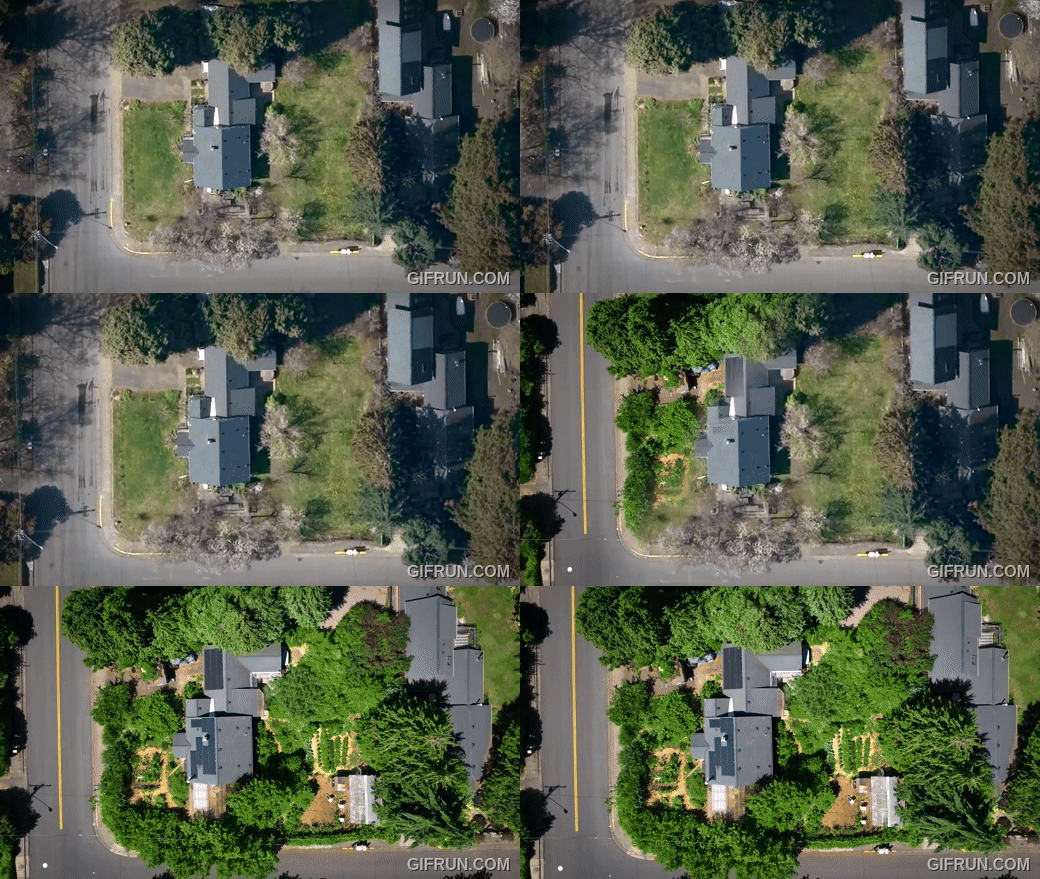
One could imagine significant positive impacts on food security and ecological health should every suburban house reflect this possibility. Personally, I would very much enjoy a reduced grocery bill if I could snap my finger and have such a garden accessible by my home. However, realistically, I have no idea how to implement this. The problem is that I can’t translate my feelings of “embracing nature’s wisdom” into “what seeds to buy”, “to be planted when”, “with what other species”.
I may be able to see tallness and appreciate it, but I can’t translate actions for it. I can’t build or support more of these qualitative things.6
The Challenge In Creating Tall Institutions
Does this mean we are doomed to be at the whims of vague qualities that we can’t quantify or formalize?
I don’t think so.
The starting place almost certainly involves a qualitative experience. To teach a person who’s never heard music before music notation or a flatland creature the notion of volume, we must recognize that they have to have some internalized notion or quality of Music or 3-D space respectively. Otherwise, it’d function about as well as teaching math to children who don’t understand why they are learning it.
“Math ain’t about numbers. If you think math is about numbers, you probably think that Shakespeare is all about words. You probably think that dancing is all about shoes. You probably think that music is all about notes. Math ain’t about numbers. Math is about logic, it’s about beauty, it’s about connections, it’s about how you get from one place to another.” – Cliff Stoll
Once we have some felt-senses of the qualities of a subject, we can begin to internalize the philosophy and principles that describe the subject. As we internalize, we are then equipped to create the expressions, like institutions, that reflect the philosophy in a way that has real-world impact.
However, to do so, there are two interrelated challenges to overcome. All the more challenging when the more “tall” a subject is, the more difficult these challenges become.
It takes time
The garden video opens with “Welcome to my garden. After 15 years, it’s dripping with so much abundance …” 15 years!? I only have, like, a couple of those! Agriculture/horticulture is mostly a metaphor in this post to illustrate an idea, I don’t have 15 years to internalize this, I’ve got other things to worry about – like paying rent or something.
It takes literacy
Like an annoying Zen master who keeps asking stupid questions like “Does a dog have a Buddha nature?” If we don’t develop literacy in the subject, we can’t understand, communicate, and learn about the rich territory the subject is describing. To deeply understand and effectively improve an institution like “America”, think about the volumes of media and history one would go through to gain literacy on its “tallness”.
Necessarily, any project or institution’s ability to perceive tallness is first set by the creator’s ability to perceive tallness. For example, if I start a garden, inexperienced and ignorant, the thrival of my garden is about as potent as the last time I tried growing tomatoes – sad, unfruitful, and dead too soon 💀. If we were to then put me in a position of influence on many such projects, let’s say, the minister of agriculture, then what’s at risk won’t just be my unfortunate tomato plant.
The taller an institution tries to be, the more it puts a demand on the creator’s ability to seed the institution with the perceptibility for tallness. Thus, to understand how to create a tall institution, we also need to understand how people learn to perceive tallness.
What separates experienced veterans and inexperienced greenhorns is the fact that the veterans have gained experience and literacy over many iterations. Fortunately, in my experience and observations, we have a natural propensity to apply ourselves. Even as soon as we begin to internalize ideas that interest us, we are naturally drawn to expressing them in our lives, whether that’s in the form of an institution or some other form of art.7
The Challenge In Maintaining Or Growing Tall Institutions
In order to maintain any institution, some form of inheritance needs to happen for its values to pass from one generation to the next.
Inheritance is also serious business. Whether it’s a dynastic line setting up an heir for an empire or simply counting on my future self to properly care for my tomato plant, only when the inheritance of values (including its metrics) succeeds can an institution be maintained. The difference can be one of decay as soon as its founder passes or a golden age lasting hundreds of years, underwriting the very history we live.
The problem with tall institutions, however, is that it is especially resistant to simplistic, dogmatic inheritance. Simply copying precedence is insufficient, one has to understand the principles from which the institutions and their founder(s) operated from.
“My grandfather rode a camel, my father rode a camel, I ride a Mercedes, my son rides a Land Rover, and my grandson is going to ride a Land Rover…but my great-grandson is going to have to ride a camel again.”
This means for a tall institution to last, it needs to:
Consistently cultivate literacy in a way that adapts to changing reality. 8
Raising/training the next generation to have the capacity for this more nuanced, complex way takes time and literacy – a kind of work. Using agriculture to illustrate again, one might say that it takes more work (in the physical energy sense) to maintain an industrial farm, but it takes a different kind of intensive work (in the mental energy sense) to maintain the garden in the video above. It would be the difference between, as Bill Mollison puts it, “protracted, thoughtful observation” and “protracted, thoughtless labor”. One can maintain the industrial farm via programmed systems of machinery to maintain planting, watering, harvesting, etc, but it takes responsiveness unavailable to rigid algorithms to tend a diverse, life-filled garden – to teach this usually requires years of working with the plants, the soil, and the seasons to understand this.
While keeping coordination feasible amongst different actors.
When something gets larger than one person’s capacity to manage, we have to then contend with multiple actors with differing capacities. This then gets exponentially harder as the group gets larger. Using the example of education now, we can try to foster Schumacher’s description of the “Whole Person”, but if everyone has a different model of “Whole Person”, then we hit a coordination conundrum. If each person is limited in their ability to understand other people’s literacy, then the aspect least understood becomes most fragile. In practice, this means that the teacher who cares about the mental health of students in a typical school could range from doing invisible labor all the way to being ostracized for being radical. This would be true for maintaining and even more so for growing.
Look, maintaining tallness over time is arguably one of the most difficult things in the universe simply because of entropy. As entropy wants to homogenize, local tallness is one of the most delicious things for it to erode.
As sometimes expressed in the humanities:
“Hard times create strong men, strong men create easy times. Easy times create weak men, weak men create hard times.”
Treasuring Tallness In Institutions and Constituents
Fortunately, Life itself is plenty competitive of a force to entropy for all practical purposes.
“Human beings were invented by water as a device for transporting itself uphill.” – Tom Robbins
Tall institutions surround us. From the skyscrapers we live into the computer I’m typing on to the languages we speak, tallness is so abundant and pervasive that it can often appear like the water we swim in. However, to the extent it’s relatively invisible (an interesting signal of the lack of ability to perceive tallness), its development and upkeep depend on those who can perceive it.9
If our ability to perceive tallness erodes, we can predict that the tallness of the institutions around us will erode too. That’s why I used education heavily as a theme in this post. Tallness in institutions and people is mutually informing. If our education itself creates flat, rather than tall, experiences, we raise a generation of people unable to perceive and inherit the tallness created by our predecessors. What results would naturally be the “hard times weak men create”.
I believe tallness is essentially, deeply beautiful. For those who see it, they can’t help but want to nurture it, cultivate it, and share that beauty with others. This is my impression of why so many institutions, from archaic bank protocols to grandmother’s kitchen, are being kept up, despite the obscurity often accompanied with preserving unperceived tallness.
The anthropologist/philosopher Gregory Bateson used to tell a story:
New College, Oxford, is of rather late foundation, hence the name. It was founded around the late 14th century. It has, like other colleges, a great dining hall with big oak beams across the top, yes? These might be two feet square, forty-five feet long.
A century ago, so I am told, some busy entomologist went up into the roof of the dining hall with a penknife and poked at the beams and found that they were full of beetles. This was reported to the College Council, who met in some dismay, because where would they get beams of that caliber nowadays?
One of the Junior Fellows stuck his neck out and suggested that there might be on College lands some oak. These colleges are endowed with pieces of land scattered across the country. So they called in the College Forester, who of course had not been near the college itself for some years, and asked him about oaks.
The new oak beams of New College, Oxford, were installed in 1865 by Gothic Revivalist Gilbert Scott, using timbers from college estates at Great Horwood and Akely in north Buckinghamshire. The building is the oldest surviving college hall at Oxford, completed in 1386 by Bishop William of Wykeham (master mason, William Wynford). The now-windowed opening in the roof was originally to let out smoke from an open fire in the center of the hall.
And he pulled his forelock and said, “Well sirs, we was wonderin’ when you’d be askin’.”
Upon further inquiry it was discovered that when the College was founded, a grove of oaks had been planted to replace the beams in the dining hall when they became beetly, because oak beams always become beetly in the end. This plan had been passed down from one Forester to the next for five hundred years. “You don’t cut them oaks. Them’s for the College Hall.”
A nice story. That’s the way to run a culture.
Every time I’ve retold this story since I first heard it from Gregory in the 1970s, someone always asks, “What about for the next time? Has a new grove of oaks been planted and protected?” I forwarded the question to the authorities at New College—the College Archivist and the Clerk of Works. They had no idea.
– Stewart Brand, How Buildings Learn
We could potentially measure these by using the size of the administrative staff as a representation of how wide it is and the functional diversity of the administrative staff as a proxy for how tall it is.
It’s worth noting that this is more helpful as an evaluative trick, rather than a prescriptively “better if it’s higher” thing. In an objective sense, simply increasing the amount we can perceive just means we get overwhelmed cognitively/computationally by what we are perceiving. There’s an art to selecting a good set of dimensions to perceive where they may synergize together. e.g. The classic notion of the human’s “5-senses” seems pretty empirically helpful, as a set of selected dimensions to perceive.
If we use somewhat stereotypical images of a serfdom vs a democracy: For a serfdom, the idea of a serf is a relatively reductive label of a human being perceivable by the state as mostly an extractive element of its own continuity, lacking the ability to perceive the tallness of humans. In contrast, the democracy, with the notion of a citizen, is usually able to perceive more dimensions of humans and is more aligned with human flourishing.
This is to note that when not coupled by disproportionately asymmetric power, spreading in a wide sense usually settles towards a functional equilibrium with the rest of the local ecology (e.g. the ~harmless kind of herpes).
It is also worthwhile to note that disturbances of existing equilibriums can often be good. Though, the world generally shows that things scaling rapidly, in a way that disregards local conditions, is often a negative phenomenon. This can range from viruses to empires/religions to AI paperclip scenarios. In the tall vs wide frame, it takes the wide strategy to such an extreme at the cost of all tallness that exists – a homogenizing influence.
At best, I can try throwing money at it and hope the market function will create more of it. However, if I can’t understand the qualitive beyond some vague feeling, I can’t even be good at discerning good and bad investments. I would be more ready to be swindled by a clever salesman than an actual good opportunity to invest in good agricultural practices.
Provided that trying things doesn’t eliminate future capacity to try things, we get to keep learning. Which is one way of describing why things like nuclear war is not cool.
Two case study of this, including how difficult this can be to get right. First is the Catholic Church’s navigation of canonizing modern saints. By canonizing the first millennial saint, the first catholic saint who’s also a programmer, memorialized in the images of his t-shirt and nike sneakers, the Church is certainly doing its own evolution of inheriting and transmitting the rather Tall values Christianity holds to subsequent generations. The second is a buddhist temple in Japan, modernizing its offerings with drone shows and music shows. Whether these will have the influence they are hoping for is definitely beyond me – time will tell.
The internet is a mighty tall infrastructure and there are many tales of its functionality being predicated on specific technologies maintained by those in obscurity. It’s tallness depend heavily on thoughtful engineers over the decades who enabled others to build more.
a lot of this reminds me of II.I of kendall's meme to end all memes, https://dissonancechamber.notion.site/II-I-Compressing-Reality-A-Defensible-Definition-of-Desire-ca55b911d32a4875ba96db98e404e483
kendall draws the analogy between metrics that are difficult to measure, and P vs NP, as they're both about the idea of something being recognizable but not necessarily implementable